
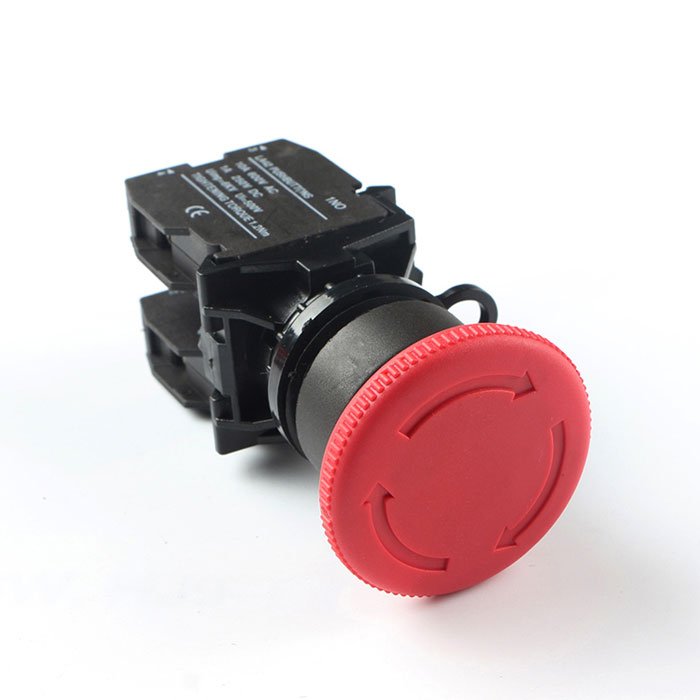
Factors of choosing normally closed contacts for emergency stop buttons
The emergency stop button contacts on electrical equipment are either normally open contacts or normally closed contacts. Therefore, people often ask whether the emergency stop button uses a normally closed contact or whether it uses a normally open contact. The factors are as follows:
1. From the moment of action
The time from closing to opening of a normally closed contact is much shorter than the time from a natural state to closing of a normally open contact. It is especially important when an emergency stop is required for the onset of risk. At this time, the shortest time, even the millisecond or even the microsecond time is very important. You know, the incident happened in a very short time.
2. From the button mechanism
The emergency stop button, whether it is a normally closed or normally open contact, will bounce from the beginning if it is not pressed in place, so that the action is effective. When using a normally open contact, when the emergency stop button is not pressed in place, the emergency stop has no effect (because the normally open contact is not closed); when using a normally closed contact, it is different, regardless of the emergency stop The button is not pressed in place, only the contact is activated, and the emergency stop is effective.
3. From its control line
The most basic effect of the emergency stop button is to park the car in an urgent situation to prevent mechanical or personal incidents. However, because of the long-term operation of the machine, there are some lines, especially emergency stop lines, which may cause faulty disconnection. At this time, if the emergency stop button uses a normally open contact, some circuit faults in the emergency stop will not be found. If the time when the emergency stop button is used then it will be too late. When using normally closed contacts, when some of the emergency stop circuits have problems, at most it will form a parking of the machine, and the loss will be relatively small.
Emergency stop is a commonly used term. In a severe sense, it should be understood as an urgent stop of the fault, that is, when a fault occurs, the relevant equipment must immediately enter a “safe” state. The safety state may be a suspension or an operation.

22
Previous Post

The classification of the push button switch(1)

Next Post

Button switch principle

Related Posts

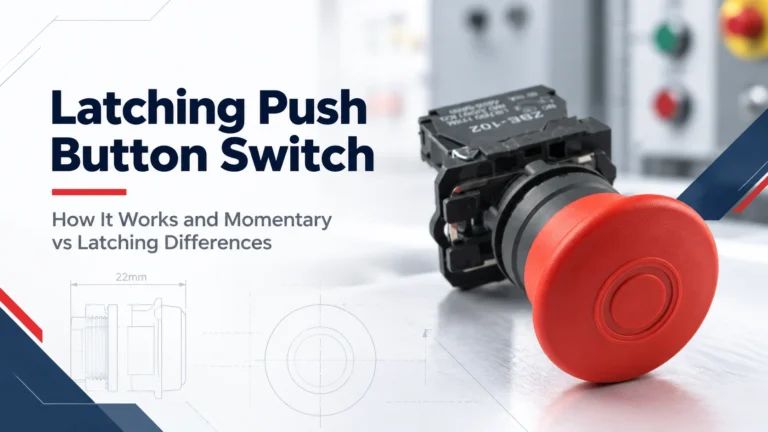
Latching Push Button Switch: How It Works and Momentary vs Latching Differences

Latching Push Button Switch: How It Works and Momentary vs Latching Differences

A Latching Push Button Switch is designed to maintain its switching state after being pressed. Unlike a momentary push button, which returns to its original position as soon as the operator releases it, a latching switch remains active until it is operated again or manually released. This makes latching push buttons useful in industrial control […]
Read More
Emergency Stop Push Button Guide: Types, Working Principle and How to Choose the Right One

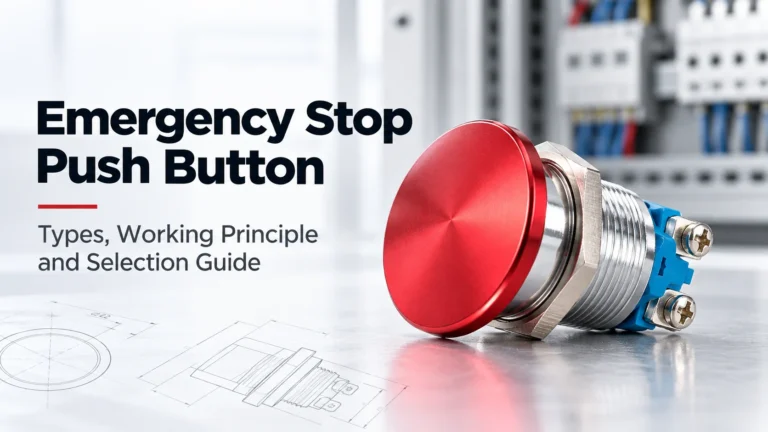
Emergency Stop Push Button Guide: Types, Working Principle and How to Choose the Right One

An Emergency Stop Push Button is a critical control component used on industrial machinery, automation systems, production lines, and control panels. Its purpose is simple: allow an operator to quickly initiate a stop command when an abnormal or potentially dangerous condition occurs. Although most emergency stop buttons use a familiar mushroom head, not all models […]
Read More
Push Button Switches: Types and Selection Tips for Engineers

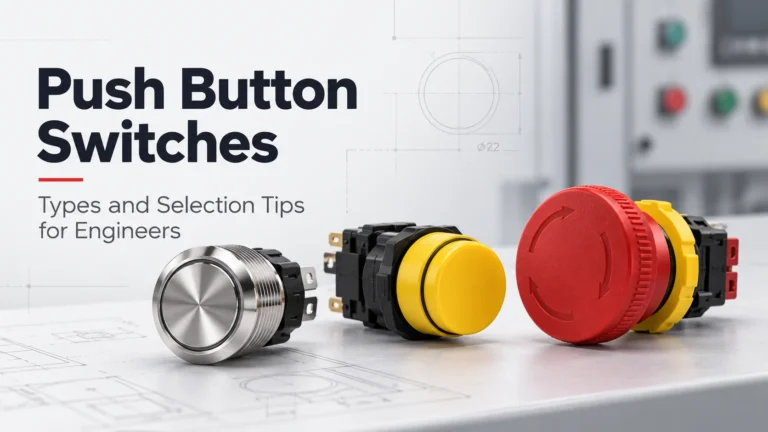
Push Button Switches: Types and Selection Tips for Engineers

A Push Button Switch is one of the most common control components used in industrial machinery, electrical panels, automation systems, and control equipment. Although the device appears simple, choosing the right push button requires more than selecting a color or mounting size. Engineers need to consider the operating method, contact configuration, rated voltage and current, […]
Read More
+86-15869659197 Phone nite@cnwuce.com E-mail