3 Position Selector Switch: How It Works, Applications & Selection Tips
Published: Author: Wenzhou Sunto
A 3 Position Selector Switch is commonly used in industrial control panels to select between different operating modes, control functions, or equipment states. With three selectable positions, it gives operators a simple and reliable way to manage machine operations without using multiple independent push buttons.
For engineers, panel builders, and industrial equipment manufacturers, choosing the right selector switch involves more than checking its appearance. Mounting size, contact configuration, electrical ratings, operating mechanism, and environmental protection all affect its performance.
In this guide, we explain how a 3 Position Selector Switch works, where it is used, and what to consider when selecting one for an industrial control application.
1. What Is a 3 Position Selector Switch?
A 3 Position Selector Switch is a manually operated electrical control device with three selectable positions. It is typically installed on a control panel and used to select different operating modes or control states.
Unlike a standard momentary push button, which activates a circuit when pressed, a selector switch allows an operator to choose between predefined positions by rotating a knob or lever.
Depending on the electrical design, the three positions may represent different functions, such as:
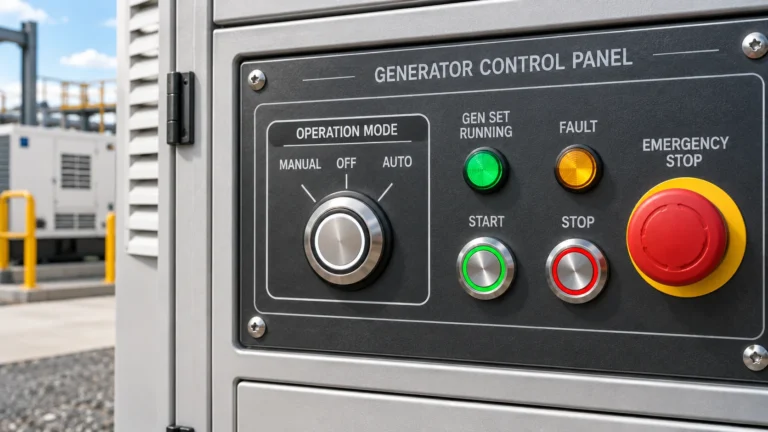
Manual / Off / Automatic
Forward / Stop / Reverse
Local / Off / Remote
These are common industrial control examples. The actual functions depend on the switch’s contact arrangement and the control circuit design.
2. How Does a 3 Position Selector Switch Work?
A 3 Position Selector Switch works by mechanically changing the electrical contact configuration when the operator rotates the selector knob.
Each position corresponds to a predefined contact state. Depending on the selected configuration, the switch can open or close different control circuits.
For example, in a Manual-Off-Automatic control system:
Manual: Enables manual operation through the control circuit.
Off: Disables the selected operating mode.
Automatic: Allows the automatic control system to manage equipment operation.
The selector switch itself does not necessarily control the motor or other high-power equipment directly. In many industrial applications, it sends control signals to contactors, relays, or PLC-based control systems.
This makes it suitable for equipment requiring several operating modes within one control panel.
3. Common Applications of 3 Position Selector Switches
Three-position selector switches are widely used in industrial equipment where operators need to select between multiple operating states.
Common applications include:
Industrial Control Panels
Used to select manual, automatic, or standby operating modes in electrical control cabinets.
Motor Control Systems
Used as part of motor control circuits to select operating commands, such as forward, stop, and reverse, when supported by the control circuit.
Machinery and Automation Equipment
Installed on production machinery to allow operators to switch between different operating modes.
Pump and Generator Control Systems
Used to select local or remote operation, automatic control, or other predefined operating states.
The exact switching functions should always match the electrical control diagram and contact configuration.
4. Key Specifications to Check Before Buying
Before purchasing a 3 Position Selector Switch, engineers and purchasing teams should evaluate several important specifications.
Specification
What to Check
Mounting Diameter
Confirm compatibility with the control panel opening
These specifications make it a potential option for industrial control panels and automatic control circuits. Actual application suitability should be confirmed against the required circuit ratings and configuration.
5. How to Choose the Right 3 Position Selector Switch
Selecting the correct model helps improve control reliability and simplifies panel installation.
Here are five factors worth considering.
1. Confirm the Required Operating Functions
First, determine what each of the three positions needs to control.
For example, a machine may require manual, off, and automatic modes. Another application may require forward, stop, and reverse control.
Do not assume that every three-position selector switch supports the same switching sequence.
2. Check the Contact Configuration
Contact configuration determines how the electrical circuit changes when the selector moves between positions.
Check the number and arrangement of normally open (NO) and normally closed (NC) contacts.
Also confirm whether the contact blocks can be combined or configured to meet your control requirements.
3. Verify the Mounting Size
The mounting diameter must match the control panel opening.
A 22mm selector switch is commonly used in industrial control panels. Check the mounting dimensions and available installation space before ordering.
4. Consider Environmental Conditions
For equipment installed in dusty or humid environments, protection rating is an important consideration.
An IP65-rated selector switch can provide protection against dust ingress and water jets under specified test conditions.
However, the complete installation, including the panel opening and sealing arrangement, also affects the overall protection level.
5. Evaluate Durability and Operating Requirements
Consider the expected switching frequency, mechanical operating life, electrical load, and maintenance requirements.
For frequently operated equipment, selecting a switch with suitable durability and properly rated contacts is particularly important.
6. Why Choose a 22mm 3 Position Selector Switch?
A 22mm mounting size is a practical choice for many industrial control panel designs.
The WUCE 3 Position Push Button Switch features a compact structure, knob-style operating head, and independent normally open and normally closed contact groups.
Its main features include:
22mm mounting diameter for panel installation.
10A conventional current rating.
IP65 protection rating.
Flame-retardant plastic housing.
Silver contacts for reliable electrical connection.
Configurable NO and NC contact groups.
For equipment manufacturers, control panel builders, and electrical component distributors, this model can be considered when a compact three-position selector control is required.
[Image Placement 2: Insert the rear view or contact configuration image of the WUCE product here.]
View the product specifications and request a quotation:
Q1. What is the difference between a 2-position and a 3-position selector switch?
A 2-position selector switch provides two selectable operating states, while a 3-position selector switch provides three. The additional position allows more control flexibility.
Q2. What does Manual-Off-Automatic mean?
It describes three operating modes. Manual allows operator-controlled operation, Off disables the selected mode, and Automatic enables automatic control.
Q3. What is the difference between a selector switch and a push button?
A standard momentary push button activates a circuit while being pressed. A selector switch allows the operator to choose between predefined positions by rotating its operating head.
Q4. What does IP65 mean for a selector switch?
IP65 indicates protection against dust ingress and water jets under specified testing conditions. It is suitable for many industrial environments, provided the complete installation maintains the required protection.
Q5. Can a 3 Position Selector Switch control a motor directly?
It is generally used in a motor control circuit to provide control signals to contactors, relays, or other switching devices. Direct motor switching should only be considered when the switch is specifically rated for that electrical load.
Conclusion
A 3 Position Selector Switch is a practical component for industrial control systems that require multiple operating modes. When choosing one, pay attention to the operating functions, contact configuration, mounting diameter, electrical ratings, and environmental protection.
For engineers, panel manufacturers, and industrial buyers, selecting a suitable model based on the actual control circuit is essential for reliable operation.
Looking for a 22mm 3 Position Selector Switch for your control panel? Contact WUCE to discuss your specifications, quantity requirements, and OEM customization needs.
A metal push button switch is more than just an operating button on a control panel. Its housing material, mounting structure, contact arrangement, and terminal design all influence how it performs in industrial equipment. For machinery manufacturers, electrical engineers, and equipment buyers, choosing the right switch means finding a balance between mechanical durability, electrical compatibility, […]
An illuminated push button switch combines manual electrical control with visual indication, helping operators identify equipment status and control functions more easily. With an integrated LED light, it provides clear feedback while maintaining the familiar operation of a standard push button. These switches are widely used in industrial control panels, machinery, automotive equipment, and electrical […]
A Push Button Switch Wiring Diagram helps engineers, electricians, and equipment manufacturers understand how to connect a push button to a control circuit. However, the correct wiring method depends on the switch’s terminal arrangement, contact configuration, and whether the product includes an indicator light. A 2-pin push button may provide a simple switching function, while […]