Push button switch is a switch that uses the push button to push the transmission mechanism of the machine to make the dynamic contact and the static contact connect or disconnect, and then realizes the circuit replacement through this. Therefore, a full understanding of the principle of button switch can better master the working mode of button switch and make household or industrial power safer.
We all know that button switch is a switch controller with simple structure but widely used. The button switch can complete a series of basic switch controls, such as start, stop, forward and reverse rotation, speed change and so on. Why can button switches complete these controls in a relatively simple structure? This requires a series of analysis from some principles of button switch.
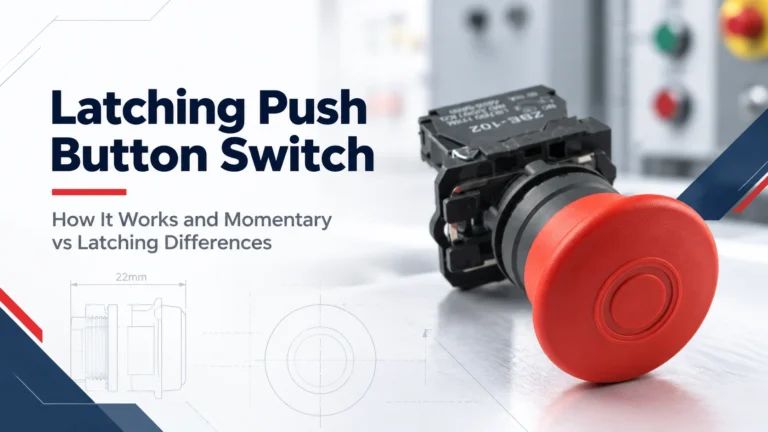
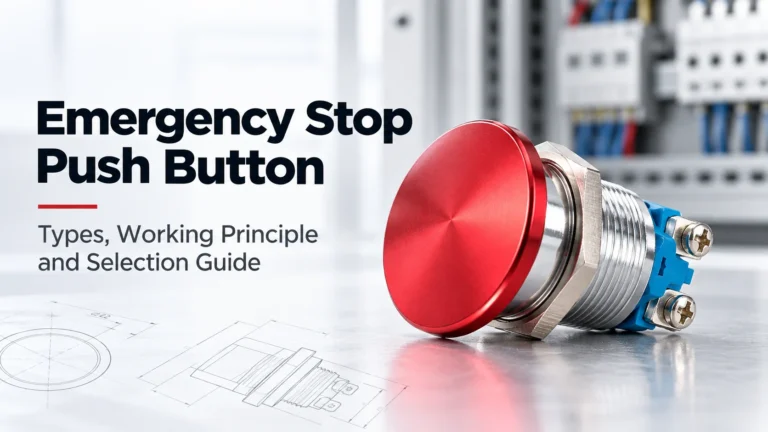
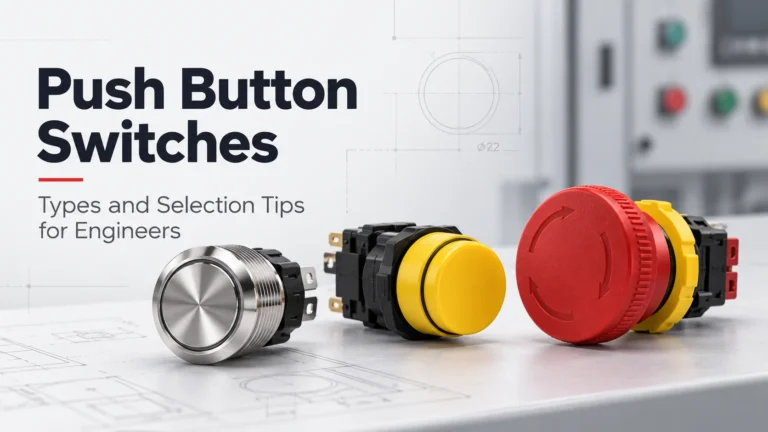
There are generally many kinds of button switches with different structures, including ordinary button type, mushroom head type, self-locking type, self resetting type, rotary handle type, type with indicator light, symbol type with light and key type, etc. Although the structure is different, their working principle is basically the same. Button switches have single button, double button, three button and different combinations. Most commonly used in families use building block structure. If we want to understand its working principle, we must first know the structure of the button switch and analyze its working principle from the structure.
Since most of the commonly used are building block structures, we will understand some building block button switch principles through the figure above. First of all, it has a button cap, so it can be called a button switch. It is the part that controls the whole button switch. Generally speaking, the button switch has two fixed contacts. These fixed contacts are divided into normally closed contacts and normally open contacts. We need to know that the normally closed contacts are opened first and the normally open contacts are closed later. These two normally closed and normally open contacts are the conversion contacts of the whole button switch and the core part of the button switch. Then we can see from the figure that there is also a movable contact and wiring in the button switch, which are indispensable accessories of the button switch.
In short, the working principle of this button switch is to press or pull it out by hand on the button cap, so that it can operate along the bearing in the switch, press or pull out the switch contact in the switch, and then the button switch can work normally.