
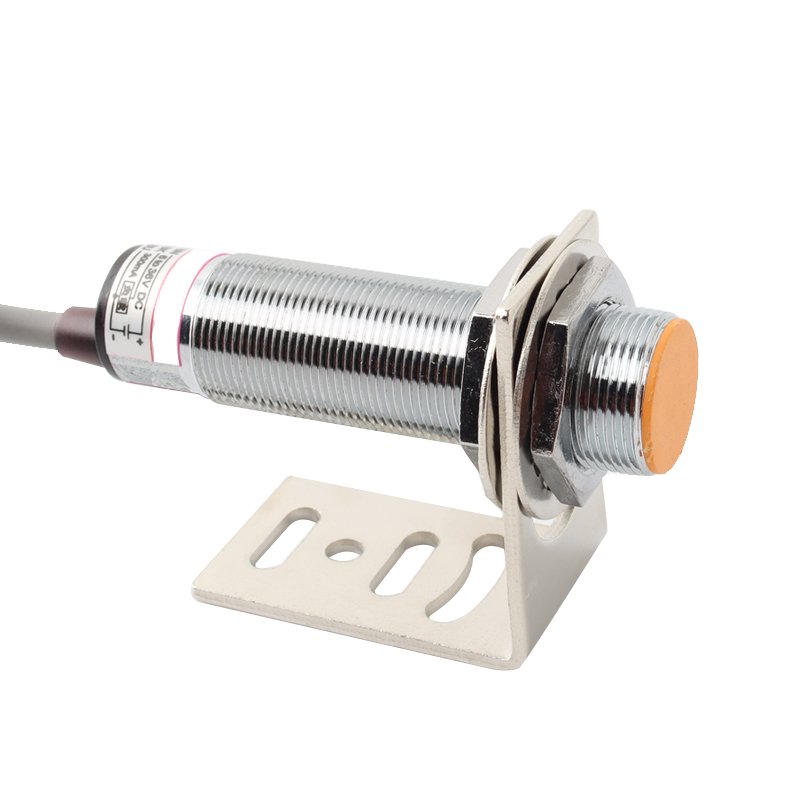
Inductive proximity switch sensor is a low cost method for non-contact detection of metal objects. When metal objects move towards or out of the proximity switch, the signal will automatically change, so as to achieve the purpose of detection. Its composition is mainly composed of three parts: amplifier output circuit, switching circuit, oscillator.
An oscillator, one of the three components of an inductive proximity switch sensor, generates an alternating magnetic field. When the metal object is close to this magnetic field and reaches the induction distance, the eddy current will be generated in the metal target, which will lead to oscillation attenuation and even stop vibration. The oscillating and stopping changes of the oscillator are processed by the rear amplifier circuit and converted into switching signals, which trigger the driving control device, so as to achieve the purpose of non-contact detection.
Inductive proximity switch sensordoes not need mechanical contact with moving parts, and the sensor surface can automatically sense the target action, thus generating drive and directly generating instructions.

Inductive proximity switch sensorcan be well used in general stroke control, its service life, positioning accuracy, operation frequency, easy installation and adjustment, as well as the ability to apply to harsh environment, is not comparable to the general mechanical switch. Therefore, it can be widely used in light textile, machine tool, printing, metallurgy, chemical industry and other industries.

5
Previous Post

How to select Inductive Proximity Sensors M24 Unshielded.

Next Post

Proximity switch sensor function

Related Posts

Latching Push Button Switch: How It Works and Momentary vs Latching Differences

Latching Push Button Switch: How It Works and Momentary vs Latching Differences

A Latching Push Button Switch is designed to maintain its switching state after being pressed. Unlike a momentary push button, which returns to its original position as soon as the operator releases it, a latching switch remains active until it is operated again or manually released. This makes latching push buttons useful in industrial control […]
Read More
Emergency Stop Push Button Guide: Types, Working Principle and How to Choose the Right One

Emergency Stop Push Button Guide: Types, Working Principle and How to Choose the Right One

An Emergency Stop Push Button is a critical control component used on industrial machinery, automation systems, production lines, and control panels. Its purpose is simple: allow an operator to quickly initiate a stop command when an abnormal or potentially dangerous condition occurs. Although most emergency stop buttons use a familiar mushroom head, not all models […]
Read More
Push Button Switches: Types and Selection Tips for Engineers

Push Button Switches: Types and Selection Tips for Engineers

A Push Button Switch is one of the most common control components used in industrial machinery, electrical panels, automation systems, and control equipment. Although the device appears simple, choosing the right push button requires more than selecting a color or mounting size. Engineers need to consider the operating method, contact configuration, rated voltage and current, […]
Read More
+86-15869659197 Phone nite@cnwuce.com E-mail