
Precautions for using button switches
There is a big difference between the button switch capabilities in AC and DC circuits, and the control capacity is very low in DC applications. This is mainly because DC does not have a zero point like AC, so it is difficult to eliminate the arc once it occurs, and the arc time is very long. And the direction of the current does not change, so there will be a phenomenon of contact migration, and the contact will not be disconnected due to unevenness, which may cause malfunction.
The constant current and surge current of some types of loads are very different. Use it within the allowable surge current value range. The greater the surge current during the closed circuit, the greater the consumption and migration of the contact, and the contact fusion and migration will cause the contact to fail to open or close.
In the case of electric induction, a back-induced voltage will be generated. The higher the voltage, the greater the energy, and the consumption and migration of the contact will increase accordingly. The control capacity is marked in the rated value, but these are not enough. For special load circuits such as voltage, current waveform, load type, etc. during on and off, the actual equipment must be tested and confirmed separately. When general-purpose silver contacts are used, contact reliability may be reduced.
When the button switch is out of the range of the button switch for the miniature, high-load type, please connect a relay suitable for the load.

11
Previous Post

Classification of Button Switches

Next Post

he Structural Characteristics of the 22mm Latching Push Switch

Related Posts

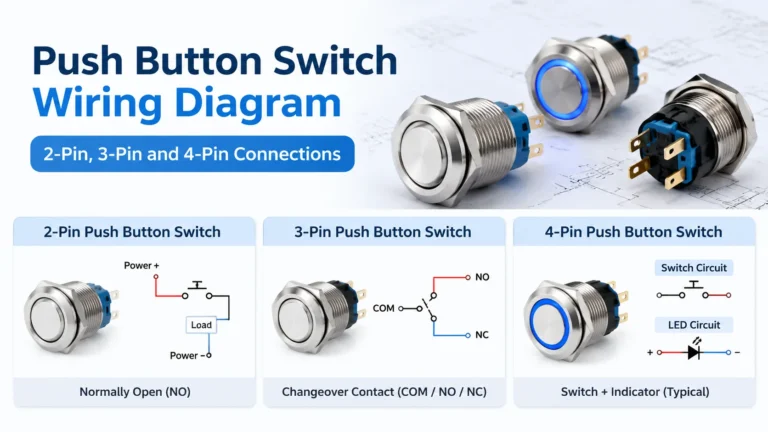
Push Button Switch Wiring Diagram: 2-Pin, 3-Pin and 4-Pin Connections

Push Button Switch Wiring Diagram: 2-Pin, 3-Pin and 4-Pin Connections

A Push Button Switch Wiring Diagram helps engineers, electricians, and equipment manufacturers understand how to connect a push button to a control circuit. However, the correct wiring method depends on the switch’s terminal arrangement, contact configuration, and whether the product includes an indicator light. A 2-pin push button may provide a simple switching function, while […]
Read More
Waterproof Push Button Switch: IP Ratings, Types and How to Choose the Right One

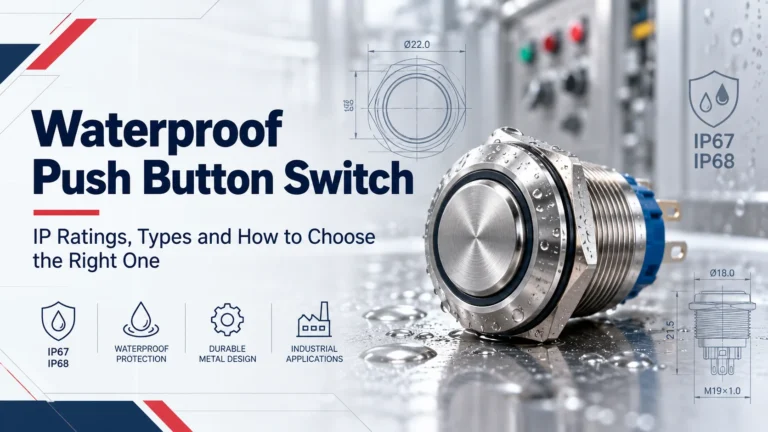
Waterproof Push Button Switch: IP Ratings, Types and How to Choose the Right One

A Waterproof Push Button Switch is designed for electrical control applications where moisture, dust, or water exposure may affect normal switch operation. It is commonly used in industrial machinery, outdoor equipment, vehicle controls, marine applications, and electrical control panels. However, not every waterproof push button provides the same level of protection. The appropriate choice depends […]
Read More
Latching Push Button Switch: How It Works and Momentary vs Latching Differences

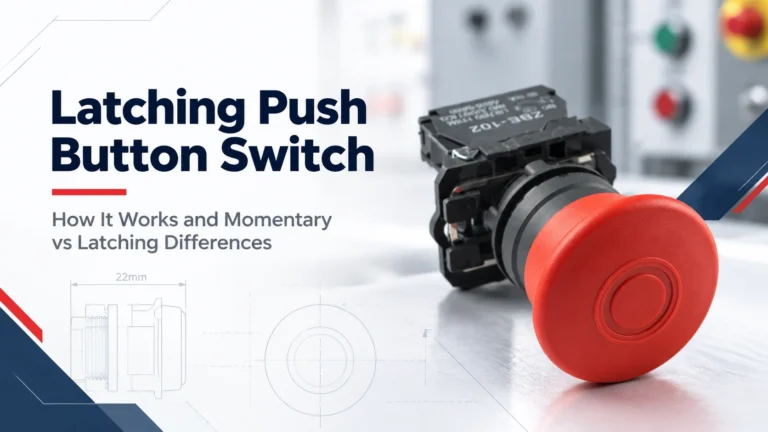
Latching Push Button Switch: How It Works and Momentary vs Latching Differences

A Latching Push Button Switch is designed to maintain its switching state after being pressed. Unlike a momentary push button, which returns to its original position as soon as the operator releases it, a latching switch remains active until it is operated again or manually released. This makes latching push buttons useful in industrial control […]
Read More
+86-15869659197 Phone nite@cnwuce.com E-mail