Metal Push Button Switch: What Engineers Should Check Before Choosing One
Published: Author: Wenzhou Sunto
A metal push button switch is more than just an operating button on a control panel. Its housing material, mounting structure, contact arrangement, and terminal design all influence how it performs in industrial equipment.
For machinery manufacturers, electrical engineers, and equipment buyers, choosing the right switch means finding a balance between mechanical durability, electrical compatibility, installation requirements, and operating conditions.
In this guide, we explore the main types of metal push button switches, explain the differences between common designs, and outline the key specifications to check before purchasing.
1. What Makes a Metal Push Button Switch Different?
A metal push button switch uses a metal button head, housing, or other structural components instead of relying entirely on a plastic construction.
Metal designs are commonly selected for equipment that requires a solid mechanical structure, a professional appearance, or resistance to frequent manual operation.
Typical features include:
Metal button heads and threaded mounting bodies
Compact panel-mounted construction
Different button colors and head styles
Multiple contact and terminal configurations
Optional LED illumination
Momentary and latching operating options
The actual construction varies by product series. Some models use stainless steel, while others use aluminum alloy or different metal materials.
Therefore, buyers should always check the manufacturer’s material specifications rather than assuming all metal push buttons have the same construction.
2. Common Types of Metal Push Button Switches
Metal push button switches are available in several configurations for different control requirements.
2.1 Standard Metal Push Button Switch
Standard metal push buttons are designed for manual control functions in machinery and electrical equipment.
They are commonly installed on control panels, operating stations, and equipment enclosures.
Their compact structure and different button designs make them suitable for a wide range of industrial applications.
2.2 Illuminated Metal Push Button Switch
An illuminated metal push button integrates an LED light into the button head or surrounding ring.
The illumination provides visual feedback to operators and helps distinguish different control functions.
Depending on the design, illuminated switches may offer:
Different LED colors
Ring or button-head illumination
Various LED supply voltage options
Different terminal configurations
This type is particularly useful in control panels where operators need to identify operating conditions quickly.
2.3 Aluminum Metal Push Button Switch
Aluminum metal push buttons use aluminum-based components in their construction.
Aluminum is relatively lightweight and offers good machinability, making it suitable for applications where weight and appearance are important considerations.
However, the actual strength and corrosion resistance depend on the alloy and surface treatment.
2.4 Anti-Vandal Metal Push Button Switch
Anti-vandal push buttons are designed with robust housings to help resist physical damage and unauthorized interference.
They are often considered for public equipment, access control systems, ticketing machines, and industrial interfaces.
When selecting this type, check the housing construction, mounting method, and specified mechanical performance.
3. Metal Materials: What Should Buyers Consider?
The material of a metal push button switch affects its weight, surface finish, mechanical properties, and environmental suitability.
Two common material options include stainless steel and aluminum alloy.
Comparison
Stainless Steel
Aluminum Alloy
Weight
Relatively heavy
Lightweight
Mechanical strength
Generally high
Depends on alloy
Corrosion resistance
Generally good
Depends on alloy and treatment
Surface finish
Brushed or polished
Anodized or other finishes
Typical consideration
Durability
Weight and appearance
Stainless steel is often considered for applications requiring mechanical strength and corrosion resistance.
Aluminum alloy can be a suitable option when lightweight construction and surface appearance are important.
The best material depends on the actual installation environment, operating conditions, and product specifications.
4. Understanding Terminal and Contact Configurations
Electrical connections are another important consideration when choosing a metal push button switch.
Different models may use different terminal arrangements depending on their internal contact structure and illumination requirements.
4.1 Normally Open and Normally Closed Contacts
Two common contact types are:
Normally Open (NO): The circuit remains open in its normal state and closes when the switch is activated.
Normally Closed (NC): The circuit remains closed in its normal state and opens when the switch is activated.
Some push button switches provide both NO and NC contacts, allowing them to support different control circuit designs.
4.2 Pin Terminal Configurations
Metal push button switches may be available with different terminal quantities, including 3-pin and 5-pin designs.
However, the number of pins alone does not determine the complete contact configuration.
For example, illuminated models may require additional terminals for LED power connections.
Before selecting a switch, check the manufacturer’s terminal diagram, contact arrangement, and wiring specifications.
5. Panel Mounting and Installation Considerations
Most metal push button switches are designed for panel mounting.
The threaded body is inserted through a prepared panel opening and secured with a mounting nut.
Before installation, consider the following:
Mounting diameter
Check the required panel-hole diameter and ensure it matches the selected switch.
Panel thickness
Verify that the threaded mounting section can accommodate the control panel thickness.
Installation clearance
Allow enough space behind the panel for the switch body, terminals, and electrical connections.
Connection method
Check whether the model uses pin terminals, screw terminals, solder terminals, or connectors.
Proper installation helps maintain mechanical stability and reliable electrical connections.
6. How to Choose the Right Metal Push Button Switch
For equipment manufacturers and electrical engineers, the following checklist can help narrow down suitable products.
1. Define the Application
Determine whether the switch will be installed in industrial machinery, control panels, commercial equipment, or other systems.
The application determines the required mechanical and electrical characteristics.
2. Select the Housing Material
Compare stainless steel, aluminum alloy, and other available materials according to weight, durability, corrosion resistance, and surface finish requirements.
3. Confirm Electrical Ratings
Check the rated voltage, current, contact configuration, and electrical load.
For illuminated models, verify the LED supply voltage separately from the switching contact ratings.
4. Check the Mounting Dimensions
Confirm the mounting-hole diameter, panel thickness, and available installation space before ordering.
5. Choose the Required Operating Function
Determine whether the application requires momentary or latching operation.
Also consider whether illuminated indicators or additional contact configurations are needed.
6. Evaluate Environmental Requirements
Consider exposure to dust, moisture, vibration, and temperature changes.
If environmental protection is required, check the actual IP rating and installation conditions specified by the manufacturer.
7. Metal Push Button Switch Options from WUCE
WUCE offers different push button switch designs for industrial equipment manufacturers and control panel applications.
Several product options can be considered according to the required construction and electrical configuration.
Aluminum Metal Push Button Switch
This product is worth considering for applications requiring a metal button design with lightweight construction.
Metal Push Button Illuminated
For equipment requiring visual indication, illuminated metal push buttons combine manual operation with LED lighting.
5 Pin Push Button Switch
For applications requiring a multi-terminal connection arrangement, this product can be evaluated according to its actual terminal and contact specifications.
When selecting a product, buyers should confirm the mounting dimensions, contact configuration, rated electrical values, and available customization options.
WUCE can provide product information to help customers identify suitable switch configurations for their equipment requirements.
8. Frequently Asked Questions
Q1: What is a metal push button switch used for?
Metal push button switches are used for manual control in industrial machinery, electrical panels, commercial equipment, and other control systems.
Q2: Are metal push button switches better than plastic ones?
Metal switches generally offer a more robust housing and different surface finishes. Plastic switches may offer advantages in weight and cost. The choice depends on the application and operating environment.
Q3: What materials are used in metal push button switches?
Common materials include stainless steel and aluminum alloy. Some products may also use brass or other metal components.
Q4: What is the difference between a 3-pin and 5-pin push button switch?
The difference is related to the available electrical terminals and connection arrangement. The exact function depends on the internal contact structure and whether the switch includes illumination.
Q5: Can metal push button switches be customized?
Depending on the product series and manufacturer, customization may include button color, surface finish, LED configuration, contact arrangement, and terminal options.
Q6: How do I select the correct mounting size?
Check the panel-hole diameter, panel thickness, threaded body dimensions, and installation clearance. Always compare these measurements with the product drawing.
Conclusion
Choosing the right metal push button switch requires more than comparing appearance and price. Material selection, electrical ratings, terminal configuration, mounting dimensions, and environmental requirements all need to be considered.
For machinery manufacturers, control panel builders, and electrical equipment buyers, checking these specifications before purchasing can help avoid installation and compatibility issues.
Explore WUCE’s metal push button switch range to find suitable options for your equipment. Contact our team with your technical requirements and order quantity to discuss product selection and customization.
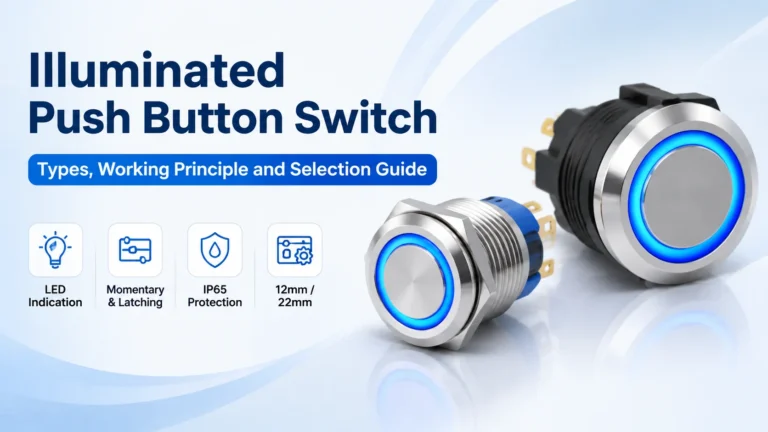
An illuminated push button switch combines manual electrical control with visual indication, helping operators identify equipment status and control functions more easily. With an integrated LED light, it provides clear feedback while maintaining the familiar operation of a standard push button. These switches are widely used in industrial control panels, machinery, automotive equipment, and electrical […]
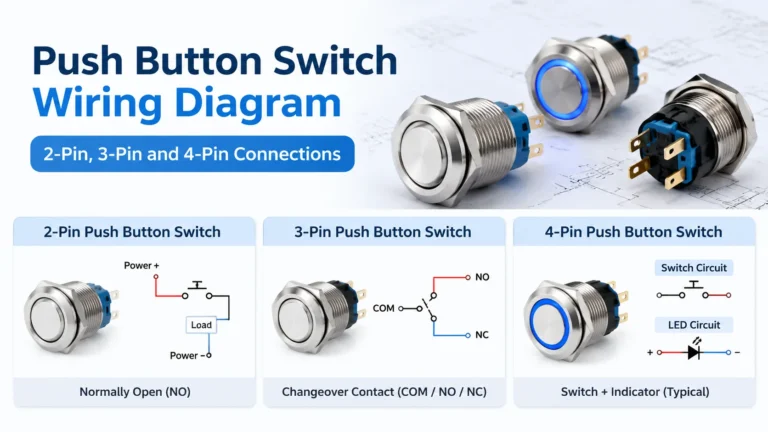
A Push Button Switch Wiring Diagram helps engineers, electricians, and equipment manufacturers understand how to connect a push button to a control circuit. However, the correct wiring method depends on the switch’s terminal arrangement, contact configuration, and whether the product includes an indicator light. A 2-pin push button may provide a simple switching function, while […]
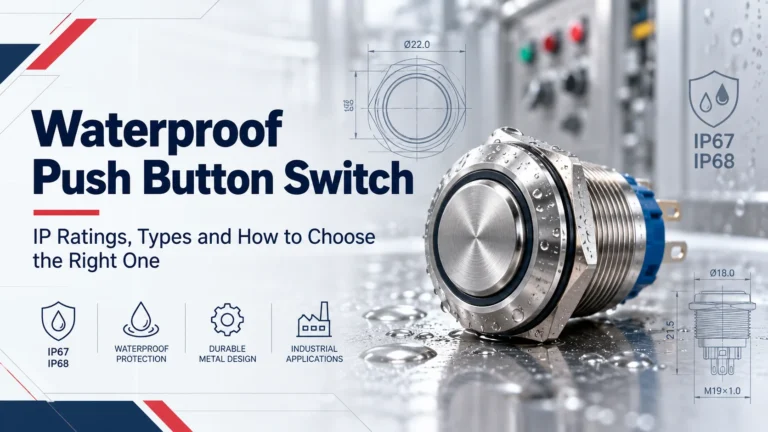
A Waterproof Push Button Switch is designed for electrical control applications where moisture, dust, or water exposure may affect normal switch operation. It is commonly used in industrial machinery, outdoor equipment, vehicle controls, marine applications, and electrical control panels. However, not every waterproof push button provides the same level of protection. The appropriate choice depends […]